

970x125
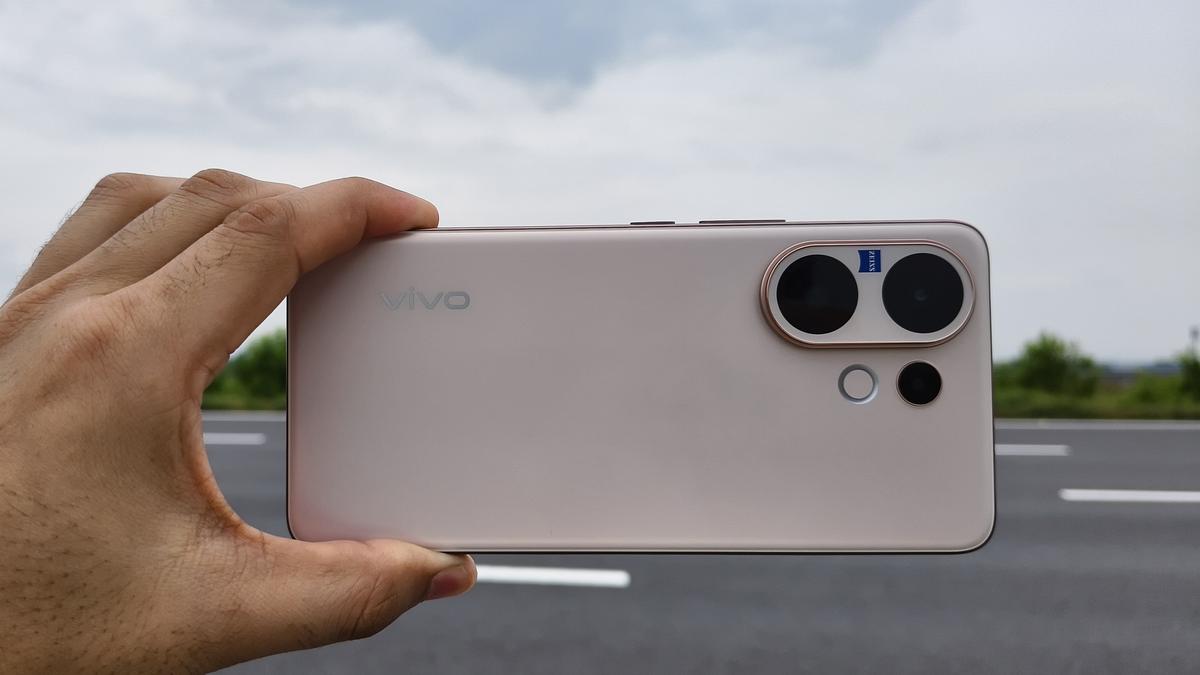
The year 2025 has been quite interesting in terms of phone launches and the range in which they come. The 30-35k segment has seen interesting entries from Poco, iQOO, OnePlus and Realme, to name a few. But Vivo has also been quite active in this segment. The company started the year with the Vivo V50, and after a gap of 5 months, it has unveiled its successor, the Vivo V60. This move certainly poses the question, ‘What’s new?’ Well, to give you a hint, the new Vivo V60 features an upgraded processor, Snapdragon 7 Gen 4 and enhanced camera prowess by adding a telephoto lens, which was missing in the Vivo V50. Let’s dive into the details and find out more.DesignThe Vivo V60 takes a different path in terms of looks compared to its predecessor. Gone is the oversized circular module of the V50; instead, Vivo opts for a pill-shaped camera island accompanied by a ring light. What really elevates the design is how the module now colour-matches with the back panel, resulting in a more cohesive, premium appearance.The review unit I received came in the Auspicious Gold finish, which looks soothing and refined. The V60 is also available in Moonlit Blue with a textured back and Mist Gray with a lighter plastic composite build. Vivo has managed excellent weight distribution, making the V60 feel slim and easy to handle. The curved sides add to the comfort, though flat edges might have provided a firmer grip. On the right side, the volume rocker and power button are placed ergonomically, falling naturally under the thumb. The bottom edge hosts the USB Type-C port, speaker grille, and SIM tray.(For top technology news of the day, subscribe to our tech newsletter Today’s Cache)Also, the phone features IP68 and IP69 certification, which means the phone can survive up to 120 minutes under 1.5m of water. Coupled with Schott Core glass protection, rated 37% more drop-resistant than the V50’s glass, the V60 undoubtedly emerges as the most durable V-series phone to date. DisplayThe Vivo V60 sticks to a familiar recipe: a 6.77-inch AMOLED display with Full HD+ resolution (2392 × 1080) and a smooth 120 Hz adaptive refresh rate. Where it improves over the V50 is in brightness, jumping from 4,500 nits peak brightness on the older model to 5,000 nits. This makes the screen more legible outdoors, even under harsh sunlight. Add HDR10+ support and a wide P3 colour gamut, and you have a panel that delivers punchy colours, deep blacks, and strong contrast. In daily use, the V60’s screen feels vibrant and responsive, whether scrolling through social media or streaming HDR content on YouTube. OS and AIOn the software side, the V60 runs FunTouch OS 15 based on Android 15. Vivo promises four years of major OS updates and six years of security patches, bringing it closer to flagship standards. This makes it a more future-proof device than the V50, which shipped with a shorter update cycle. AI features see notable refinement too. You get Vivo’s advanced AI photo-editing tools like Reflection Remover, Magic Eraser, and AI Move, which work seamlessly to fix photos. The highlight, however, is the new AI Four Season Portraits, allowing users to capture images with seasonal backdrops. Combined with existing features such as AI Eraser and Circle to Search, the V60 enhances both productivity and creativity. Compared to the V50, these additions make the user experience richer and more versatile. PerformancePowering the Vivo V60 is the Snapdragon 7 Gen 4, built on a 4nm process. This is a step up from the Snapdragon 7 Gen 3 in the V50, offering higher efficiency and performance gains. Our review unit with 8 GB RAM and 256 GB storage handled daily multitasking without hiccups, while additional configurations up to 16 GB + 512 GB are available for power users. The storage uses UFS 2.2, which is slightly dated compared to faster UFS 3.1 seen on rivals. In benchmarks, the V60 scored 1,199 in single-core, 3,351 in multi-core, a GPU score of 4,603, and an Antutu score of 956,066. These numbers reflect solid upper mid-range performance, but competitors like the Poco F7 and iQOO Neo 10 with Snapdragon 8 series chips are simply more powerful in raw numbers. That said, the V60 delivers smooth day-to-day usage with minimal lag, making it suitable for mainstream users. Gaming was also a strong point. Titles like BGMI and Call of Duty Mobile ran consistently at high settings with no frame drops, and the advanced cooling system ensured temperatures stayed in check during longer sessions. While hardcore gamers might gravitate towards iQOO or Poco for sheer horsepower, the V60 balances performance and stability well.CameraWhere the Vivo V60 makes the biggest leap over the V50 is in its camera system. The new phone ditches the dual setup for a Zeiss-backed triple camera array. The telephoto lens is the standout addition here, filling a glaring gap from the V50. It features a 50 MP OIS primary sensor (Sony IMX776), a 50 MP telephoto sensor with 2x optical zoom (Sony IMX882) and an 8 MP ultrawide lens with 120° FoV.
Vivo V60 camera sample
| Photo Credit:
Haider Ali Khan
In daylight, the main camera produced crisp shots with excellent detail and a cooler tone compared to the warmer hues of the V50. Dynamic range is improved, shadows are better exposed, and colours pop, though at times, Vivo leans toward boosted saturation, something social media users may enjoy.
970x125
Vivo V60 camera sample
| Photo Credit:
Haider Ali Khan
The telephoto lens elevates portrait photography with more natural depth and clarity. Edge detection, however, still struggles occasionally with complex backgrounds. Vivo has added Stage Mode, which improves digital zoom up to 10x, though it doesn’t always switch seamlessly to the telephoto lens. Still, this lens alone makes the V60 a more versatile shooter than the V50.
Vivo V60 camera sample
| Photo Credit:
Haider Ali Khan
Low-light performance is good too. The Aura Light and AI enhancements help brighten scenes, but on some occasions one can spot grain and limited dynamic range. Compared to the V50, night images are sharper and improved. Portraits, however, benefit from new filters like Wedding Vlog and Film Camera Mode, which add creative flair to social captures.
Vivo V60 camera sample
| Photo Credit:
Haider Ali Khan
On the selfie front, the 50 MP Zeiss front camera delivers sharp images with good shadow detail. The V60 favours slightly contrast-heavy skin tones, which may not always look natural but will appeal to those who prefer enhanced aesthetics.
BatteryThe Vivo V60 houses a 6,500 mAh battery, a step up from the V50’s 6,000 mAh. With between moderate to heavy use, the phone comfortably lasted more than a day and a half, making it one of the strongest battery performers in its class. Despite the large cell, Vivo keeps the form factor slim, which is commendable.
Charging remains 90W fast charging, identical to the V50. It can charge from 20% to 100% in about 40 minutes, which is still competitive but no longer a segment leader, as some rivals now push 120W or higher speeds. Nevertheless, the bigger battery means the V60 edges out the V50 in longevity, if not in charging speed.
VerdictThe Vivo V60 lives up to the expectations of being a worthy successor. It brings a refreshed design, brighter display, longer battery life, and, most importantly, a triple-lens camera system with telephoto capabilities, something the Vivo V50 lacked. However, at a launch price of ₹36,999, it’s about ₹2,000 higher than the V50, which may not sit well with buyers considering powerful alternatives like the OnePlus Nord 5, Poco F7, and iQOO Neo 10, all of which boast stronger processors.Still, the V60 carves out its niche with durability, software support, creative camera features, and a massive battery in a slim design. For existing V-series users or anyone who prefer design, durability, and photography, the Vivo V60 is a polished upgrade that stays true to the series’ legacy while pushing it forward in meaningful ways.
970x125
