

970x125
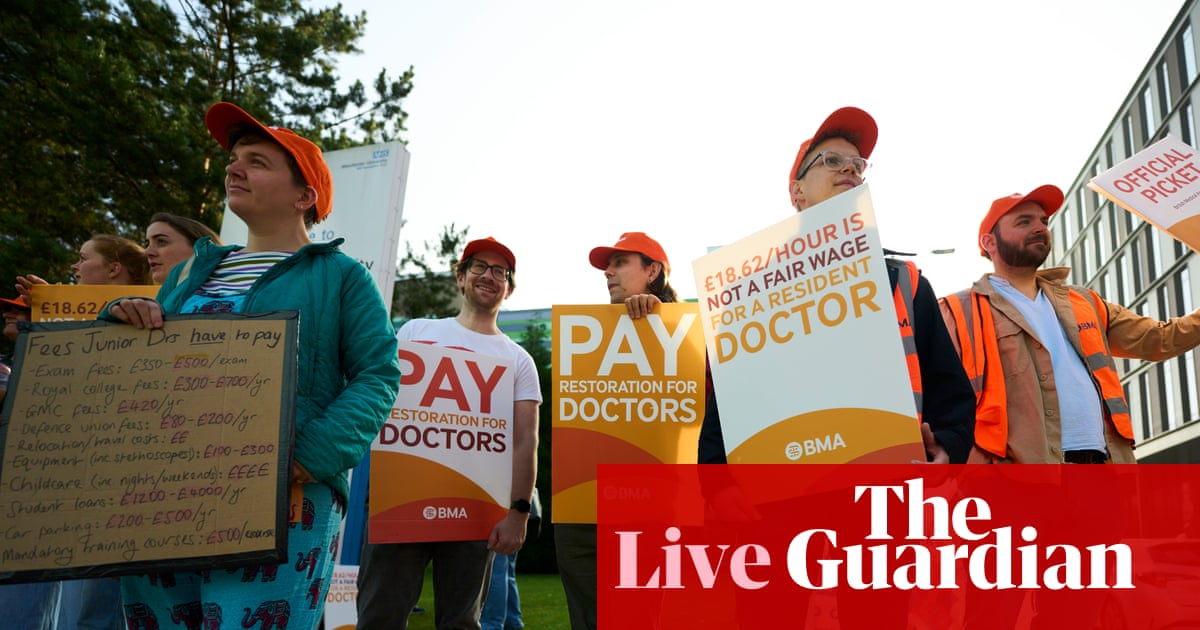
Doctors begin five days of strikes in EnglandHello and welcome to our rolling UK political coverage, with this morning’s headlines dominated by new industrial action hitting the NHS.Resident doctors in England have begun strike action after the British Medical Association and government failed to reach an agreement over pay restoration.Up to 50,000 people went on strike at 7am, with the action intended to last for five days until 7am on Wednesday 30 July.The public have been urged to keep coming forward for NHS care during the strike. GP surgeries are open as usual and urgent care and A&E will continue to be available, alongside 111, NHS England said.Keir Starmer made a last-minute appeal to resident doctors, saying the strikes would “cause real damage”.The health secretary, West Streeting, had warned that the industrial action “enormously undermines the entire trade union movement”.In an article for the Guardian on Thursday, Streeting said the decision by the BMA to push for new strikes immediately after receiving a pay rise of 22% to cover 2023-24 and 2024-25 was unreasonable and unprecedented.We’ll bring you all the latest news on the strike, and other political stories, throughout the day.ShareUpdated at 08.12 BSTKey eventsShow key events onlyPlease turn on JavaScript to use this featurePatients at St Thomas’ Hospital have voiced their support for junior doctors taking part in the latest round of strike action over pay and conditions.Jo Irwin, 72, who was attending the London hospital for a blood test before surgery for a hernia, said she had “no hesitation” in backing the walkout.“I am fully behind the strikes and the public should be as well,” she said.“Without these doctors I would be dead. They are looking after sick people. I am very angry about it.“They should get all the money they want – and more than Keir Starmer and his cronies.”Mohammed Dinee, 42, from Brixton, also gave his backing to the industrial action after being admitted recently with back pain.“Today I had a physiotherapy appointment – it was fine, no complaints,” he said. “But I got admitted other day for back pain – you could feel it. It was difficult to get an MRI scan.“They’re strained – being inside St Thomas’, you can see it. I fully support them.”SharePeter Kyle also defended the government’s resistance to calls for immediate UK recognition of a Palestinian state, insisting Keir Starmer wants sovereignty “more than anyone else” as part of a political process.The technology secretary was repeatedly asked why Britain will not follow France in saying it will recognise a Palestinian state.He told Sky News: “We want Palestinian statehood. We desire it, and we want to make sure the circumstances can exist where that kind of long-term political solution can have the space to evolve and make sure that it can become a permanent circumstance that can bring peace to the entire region. But right now, today, we’ve got to focus on what will ease the suffering, and it is extreme, unwarranted suffering in Gaza that has to be the priority for us today.”Asked why the UK was holding back on confirming recognition, he said: “Because we believe that statehood is something that is a political process, and it should be part of the political settlement that will lead to a safe and secure Israel and a Palestinian statehood with all the sovereignty that goes alongside it.”He added: “I don’t want anybody who is viewing this to underestimate our anxiety about what is happening in Palestine, in Gaza right now, and our desire to deliver a Palestinian state.”Kyle said the debate in the Labour party was over how statehood is reached rather than whether it is reached, adding: “Keir Starmer wants this more than anyone else, but believes it is a crucial step towards delivering the peace and security into the future, and needs to be a negotiated peace within the region itself. It can’t be forced.”ShareMeanwhile, a cabinet minister has said “the chaotic Jeremy Corbyn” does not “think about governing, he thinks about posturing” in an attack on the former Labour leader.Asked about Corbyn’s launch of a new party, Technology Secretary Peter Kyle told Times Radio: “I was a Member of Parliament in the Labour Party when Jeremy Corbyn was leader, and the chaos and instability that he brought to our party I’m now viewing him wreak in his new party, and I’m just very glad that I’m looking on it from the outside this time, rather than having to experience it from the inside.”Asked about Corbyn’s claim that Labour is a “top-down” outfit full of “control freaks”, Kyle said: “Well, look, Jeremy says a lot of things, but the thing that worries me the most about what he says is that he doesn’t want to spend money defending our country, that he is against the money that Labour is investing into the defence of our country. At the moment, these are the things that should fundamentally worry us about the words of Jeremy Corbyn.“He’s not a serious politician. He doesn’t think about governing, he thinks about posturing. And we see that writ large at the moment, because all the posturing, of course, just puts him at odds with his own supporters, which is why you’ve got George Galloway saying he won’t join it.“And you’ve got, you know, they… can’t even agree a name before launching their party. This is the kind of chaotic circumstances that follows Jeremy around like a trail… I never quite understood his leadership, even when I was experiencing it up close, but that’s for them to decide.“The Labour party is now led by somebody who has the very clear interest of our country at heart. It is country first, and that’s the kind of thing I think people are responding to.“We see Keir acting incredibly well on the international stage in recent months, tackling some of the big issues facing the world and its economy and he’s thrown himself into fixing our public services. I think this is the kind of leadership that people respond to, not that of the chaotic Jeremy Corbyn.”ShareResident doctor Kelly Johnson said Wes Streeting’s opposition to the strikes felt like “a slap in the face”.Speaking outside St Thomas’ Hospital, where she works, she told the PA news agency: “Every union has the right to strike. It feels like a slap in the face to say that we are doing something that is unjust. Just because we’re doctors doesn’t mean we can’t come out and strike and protest for what we think is right.”She added: “When doctors decide to take strike action it’s always portrayed as though we’re being selfish but we’re here as a body to help the public day in day out to work hours that don’t even end sometimes.“Here we are just trying to get what’s right for us so we can do our best to serve the public.”ShareSpeaking outside Leeds General Infirmary, paediatrics registrar Cristina Costache said: “Reducing the waiting list is a really good target but you’re going to reduce the waiting list if you increase the numbers of posts, if you give better pay so the jobs don’t leave for another country, like I did from my home country.“You’re going to feel differently when you come to work if you feel valued, it just makes such a big difference. It makes that extra tiredness, that extra coming in and giving away the time that you could have spent with your parents that are ill, or with your family, or with your children. So they have to think about that rather than numbers.“I look after quite rare diseases in children and my patients aren’t numbers.”Dr Costache said she left Romania due to the poor health infrastructure and lack of investment.She said: “It’s really sad to have seen in the last nine years, since being here, how the NHS is heading that way. Hence, I’m a trade unionist because I feel like I want to tell people please ‘don’t do what has happened there’.“It can be really scary and really bad, and you don’t want to be in that place.”ShareAround 30 doctors and supporters gathered outside Leeds General Infirmary (LGI) on Friday morning, waving placards and cheering as passing cars beeped horns in support.Cristina Costache, who is a paediatrics registrar at the LGI and a PhD student, said: “It’s a very difficult decision to make always, because I love my job and that’s the reason I went into it. I get depressed if I’m not in work. My heart is always at work.“But I also care about my colleagues and my profession.”Dr Costache said: “I’m seeing more and more gaps as registrars. There’s always a gap on the paediatric registrar rota. We end up having to cover the job of another paediatric registrar, of even two other paediatric registrars.“My SHOs (senior house officers) also have gaps, so I sometimes have to cover their job as well as my registrar job. And that’s not safe and that’s not OK.“And the reason that that happens is that they’re poorly paid. If you’re poorly paid, why would you want to come in on your free time when you know you’re going to be on nights the next day and then so three or four nights in a row?”ShareDave Bell, a retired nurse and member of the campaign group Keep Our NHS Public, stood in solidarity with striking doctors outside St Thomas’ Hospital.“Britain’s doctors are the backbone of our NHS,” he said. “If you ask anyone who’s been to a hospital, they’ll tell you those staff work their socks off.”He called for urgent pay restoration, adding: “We need to value those doctors and restore their pay to what it was 15 years ago.”But he acknowledged the difficulty of strike action within NHS teams.“I took strike action once when I was a nurse – of course it causes tensions. You’re working hard, and if medical staff walk out, it gets even harder for those still in.”Despite this, he said unity was crucial, adding: “In the long run, people have got to work together – the unions too. It can be overcome.”ShareBMA council chairman, Dr Tom Dolphin, told BBC Radio 4’s Today programme “nobody wants to be on strike” but Wes Streeting’s offer “did not contain anything substantive”.He added: “Where we were last year when we started the pay campaign, we were down a third on our pay compared to 2008. So you’ve got last year’s pay offer which did indeed move us towards (pay restoration), but Wes Streeting himself said that pay restoration is a journey, not an event, implying that there would be further pay restoration to come, and we were expecting our pay to be restored in full – that’s our campaign’s goal.“We got part way there, but then that came to a halt this year – we’ve only had an offer that brings us up, just to catch up with inflation.”Asked what it would take for doctors to go back to work, he said the BMA needed to see “a clear, guaranteed pathway” to pay restoration.He added that “it’s very disappointing to see a Labour government taking such a hard line against trade unions”, adding: “They’re talking about punishing the trade union, talking about punishing doctors, holding them back in their training, making sure that they don’t get locum shifts, that kind of thing.“People are talking about that which, of course, is not legal. And if we find cases of people being held to detriment for having taken part in strikes, we’ll be fighting their case for them. It’s just disappointing to hear that kind of rhetoric coming from a Labour administration.”ShareHere are some images from the strikes this morning…NHS resident doctors protest outside Royal Victoria Infirmary in Newcastle. Photograph: Owen Humphreys/PANHS resident doctors outside St Thomas’ Hospital in London. Photograph: James Manning/PANHS resident doctors outside St Thomas’ Hospital in London. Photograph: James Manning/PAShareStriking doctors say their demand is simple – restore pay to 2008 levels.Dr Ryan said: “We want to be paid fairly and we want an excuse to stay in the NHS and do what we enjoy, which is looking after patients.”She argued that doctors have seen the worst pay erosion across the public sector and said: “Doctors should not need to subsidise the NHS with their wages.”Dr Ryan apologised to patients for the disruption caused by the strike, saying: “It really is disruptive – and I’m sorry for that.”But she added: “I apologise to patients every day because the NHS isn’t giving them the service they deserve.”“We’re under-doctored and understaffed. And that’s a political choice not to fund this properly.“We need a government that will invest in the NHS, not only for me, but also for the patients.”ShareDr Melissa Ryan, co-chairwoman of the BMA’s UK resident doctors committee, told the PA news agency that rising living costs are forcing many doctors into debt.She said a first-year doctor with £80,000-100,000 of student debt can expect to lose 9% of their salary for life repaying it.“We work long nights and unsociable hours, get flung around the country, and still some of us struggle to pay rent,” she said.“That’s because our pay has been eroded by 21% since 2008 – it’s like working one day a week for free.”ShareAround 15 doctors and supporters are gathered on Westminster Bridge, near the entrance to St Thomas’ Hospital, as the latest round of NHS strike action gets under way.Some are holding placards reading “£18.62/hour is not a fair wage for a resident doctor”, and “Pay doctors, not PPP.”Others have printed out an old tweet by health secretary Wes Streeting accusing the previous government of failing to prevent strikes, PA reported.One man is standing beside the striking doctors, selling copies of The Socialist newspaper to passers-by.Chants of “What do we want? Fair pay. When do we want it? Now” echo across the bridge.NHS resident doctors outside St Thomas’ Hospital in London, as resident doctors in England, formerly referred to as junior doctors, begin a five-day strike after talks with the Government collapsed over pay. Photograph: James Manning/PAShare
970x125
970x125
