

970x125
UK inflation accelerates to 3.8% on higher air fares, petrol and food pricesUK inflation has accelerated more than expected to 3.8% in July, the highest annual rate since early last year, driven by higher transport costs, such as air fares, and food prices.It’s the second month in a row that inflation has surprised on the upside.It compares with an annual increase in the consumer prices index of 3.6% in June, according to the Office for National Statistics.The core rate, which strips out food and energy, rose to 3.8% from 3.7%, also higher than expected.ShareUpdated at 07.57 BSTKey eventsShow key events onlyPlease turn on JavaScript to use this featureHere are 10 examples of potential rail fare rises in England next year, compiled by PA.Figures are based on an increase of 5.8%. The table compares the cost of season tickets using any valid route bought before and after the rise.Annual season tickets:ROUTE – PREVIOUS PRICE – PRICE AFTER 5.8% RISE – INCREASE
Woking to London – £4,260 – £4,507 – £247
970x125
Gloucester to Birmingham – £5,384 – £5,696 – £312
Whitehaven to Carlisle – £2,508 – £2,653 – £145
York to Leeds – £3,028 – £3,204 – £176
Bournemouth to Southampton – £3,676 – £3,889 – £213
Flexi tickets for travel two days per week over a year:
Welwyn Garden City to London – £2,029.20 – £2,146.90 – £117.70
Liverpool to Manchester – £2,074.80 – £2,195.10 – £120.30
Cambridge to London – £4,620 – £4,888 – £268
Ipswich to Peterborough – £4,947.60 – £5,234.60 – £287
Bath Spa to Bristol Temple Meads – £1,056 – £1,117.20 – £61.20
ShareSome economists now expect interest rates to be on hold this year, while the EY Item Club forecasting group says November is a ‘close call’.Elliott Jordan-Doak, senior UK economist at Pantheon Macroeconomics, said:
All told, July’s consumer prices report showed headline inflation matching the monetary policy committee’s (MPC) forecasts, as outlined in the August monetary policy report (MPR).
Services inflation exceeded the MPC’s expectations, but that jump in services consumer prices index (CPI) was partly driven by a sharp move in the erratic airfares component, which could unwind in August’s data. That said, the doves on the MPC have taken a battering over the past week. July’s figures show sticky underlying services inflation and are another blow to those on the MPC that argued hard at the August meeting about the disinflationary process being underway.
What’s more, the prices data come on the back of a GDP report that smashed consensus estimates, and a labour market report that showed the jobs market stabilising. It is also easy to forget that inflation in July was also well above the MPC’s expectations just a few months ago in the May MPR for instance, which projected headline inflation of 3.4%, and services CPI of 4.7%. T
The big picture remains that inflation is set to stay miles above target for the foreseeable future; we expect headline inflation to remain above 3% until April 2026, forcing the MPC to stay on hold for the rest of this year at least.
Matt Swannell, chief economic advisor to the EY Item Club, said:
Base effects mean CPI inflation is likely to edge up further over the next couple of months and peak in September. Subsequently, inflation should cool gradually. The positive contribution from the energy category is expected to fade towards the end of this year and into next. Meanwhile, food price inflation should slowly cool, as the impact of stronger sterling gradually feeds through. Though services inflation is likely to remain sticky in the near-term, it will start to soften next year, as pay growth continues to cool and the impact of businesses passing on this year’s increase in employers’ National Insurance Contributions (NICs) fades.
In the minutes of its August meeting, the MPC sent a clear message that inflation was its priority again. However, there wasn’t much in today’s release that should add to the committee’s concerns, with headline inflation in line with the Bank of England’s staff projections and its measure of underlying services inflation softening. November’s meeting will be a close call, with the hawkish shift at the August meeting leaving much greater uncertainty around the timing of the MPC’s next cut.
ShareUpdated at 08.05 BSTThe chancellor of the exchequer, Rachel Reeves, conceded that “there’s more to do to ease the cost of living”. She said:
We have taken the decisions needed to stabilise the public finances, and we’re a long way from the double-digit inflation we saw under the previous government, but there’s more to do to ease the cost of living.
That’s why we’ve raised the minimum wage, extended the £3 bus fare cap, expanded free school meals to over half a million more children, and are rolling out free breakfast clubs for every child in the country. Through our plan for change we’re going further and faster to put more money in people’s pockets.
The Unite union called for higher pay rises, to offset higher inflation.Unite general secretary Sharon Graham said:
Once again, the soaring cost of basic essentials like food and water is pushing families to the brink. Workers and their families are struggling to pay excessive bills. Pressure needs to be taken off family budgets by giving workers a pay rise. The time for action is now.
ShareUpdated at 08.06 BSTInflation in the UK is running higher than in the US, where it held at 2.7% in July, and in the eurozone, where it is at 2% and is expected to remain around that level – in line with the European Central Bank’s target – in the coming years.Inflation in the UK’s dominant services sector, which is closely watched by the Bank of England, accelerated to 5% in July from 4.7% in June.Our full story is here:ShareUpdated at 07.52 BSTExpectations of Bank of England rate cut this year recedeThe rise in inflation has all but wiped out hopes of a September interest rate cut.Financial markets see a less than 5% chance of a reduction then.Chances of another rate cut from the Bank of England before the end of the year have also receded, and the next quarter-point reduction is only fully priced in next spring. The central bank last cut rates earlier this month by a quarter point to 4% but only after a narrow 5-4 vote by policymakers on the monetary policy committee.The pound gained by 0.1% against the dollar to $1.3511 after the inflation data.Suren Thiru, economics director at the Institute of Chartered Accountants in England and Wales, said:
These figures underscore the intensifying financial squeeze on households and businesses as a summer holiday spike in food and flight costs helped push inflation uncomfortably higher, despite July’s drop in energy bills.
Increasing services inflation suggests that rising National Insurance and National Living Wage costs are exacerbating underlying price pressures by more than offsetting the current downward squeeze from looser labour market conditions.
While spiralling business costs and food prices may mean that inflation peaks higher than the Bank of England’s prediction of 4%, it should start decelerating in the autumn as a weaker economy increasingly bears down on prices.
July’s outturn probably extinguishes hope of a September interest rate cut, while strengthening underlying inflationary pressures calls into question whether policymakers will be able to relax policy again this year.
ShareUpdated at 08.09 BSTJim Bligh, director of corporate affairs and packaging at the Food and Drink Federation (FDF), warned that” high food and drink inflation will persist through the year”. He said food and drink manufacturers are being squeezed by higher energy and ingredient costs and have no choice but to pass some of the increases on to customers.
Today’s figures show that food and drink manufacturers are being squeezed on all sides. Energy prices remain high, and the cost of some key ingredients has surged in recent years. Cocoa prices are at a 45-year high, and both olive oil and butter prices have doubled since 2020.
With high commodity prices, the new £1.4bn packaging tax, and increased National Insurance costs, it’s no surprise that many food and drink manufacturers have seen their costs increase by 10% or more this year.
Manufacturers have absorbed as many of these costs as possible, but consumers will still see higher prices at the till. We expect that high food and drink inflation will persist through the year, so any fresh costs for businesses in the Autumn Budget will inevitably put yet more pressure on shoppers’ pockets.
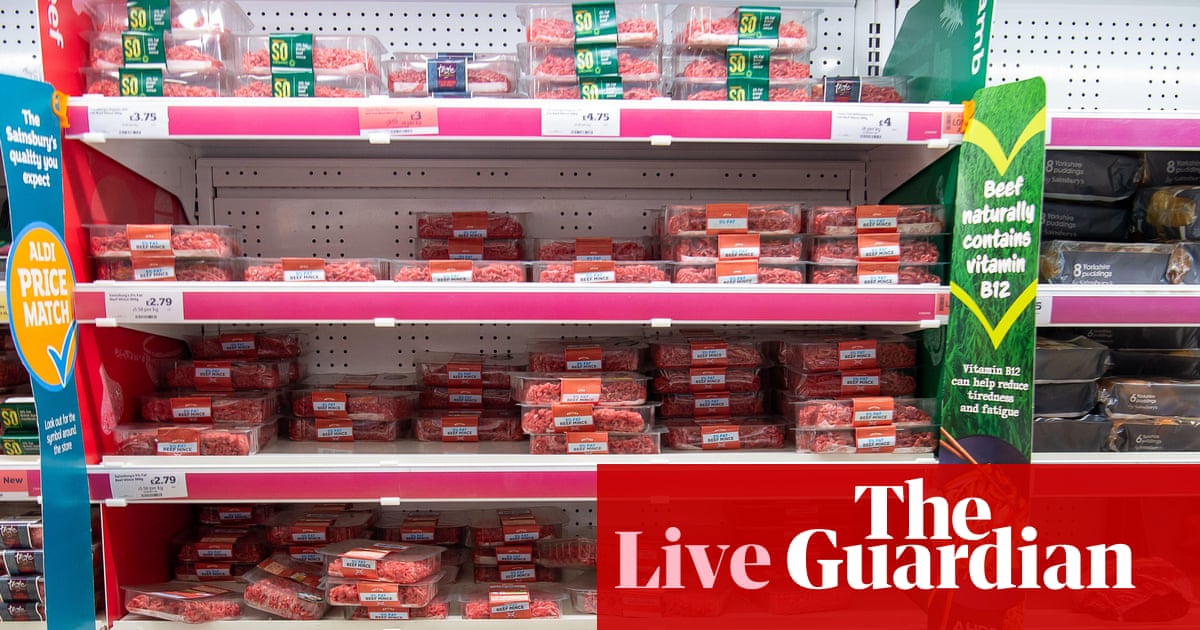
Five categories saw inflation in double digits: beef and veal (24.3%), coffee (18.0%), butter (17.8%), chocolate (17.2%) and whole milk (11.3%).
Prices fell the fastest for: olive oil (-10.6%), sugar (-2.8%), frozen seafood (-2.6%), and rice (-2.5%).
Wholesale UK butter prices are doubled compared to Jan-20
ShareFood prices rise at highest rate since February 2024Food prices rose at the highest rate since February 2024 (but below the peak seen in early 2023), with beef and fresh orange juice among the items that became more expensive.Food prices rose by 4.9% in July, up from 4.5% in June.Statisticians said there were price rises for meat (mainly beef); sugar, jam, honey, syrups, chocolate and confectionery (mainly chocolate assortments); coffee, tea and cocoa (mainly instant coffee); and mineral waters, soft drinks and juices (mainly fresh orange juice).ShareRail fares in England on track to rise by as much as 5.8% next yearRail fares in England are on track to rise by as much as 5.8% next year, sparking concern among passenger groups.Increases in rail ticket prices are usually calculated by adding one percentage point to July’s inflation reading on the retail prices index (RPI), which was 4.8%. The government has not confirmed how it will determine the cap on regulated fare rises in 2026, but this year’s 4.6% hike was one percentage point above RPI in July 2024.Regulated fares, which account for about half of rail journeys, would rise by 5.8% in 2026 if the increase follows the same pattern as last year.ShareUpdated at 07.19 BSTAir fares jump due to timing of school holidays; petrol and diesel prices also riseAir fares rose by 30.2% between June and July, compared with a monthly rise of 13.3% a year earlier.The increase is the biggest July increase since the collection of air fares changed from quarterly to monthly in 2001, and was probably influenced by the timing of school summer holidays.Petrol and diesel prices also rose, with the average price of petrol up by 2p a litre between June and July while diesel rose by 2.9p a litre, compared with price declines in the same period last year.ShareUpdated at 07.24 BSTUK inflation accelerates to 3.8% on higher air fares, petrol and food pricesUK inflation has accelerated more than expected to 3.8% in July, the highest annual rate since early last year, driven by higher transport costs, such as air fares, and food prices.It’s the second month in a row that inflation has surprised on the upside.It compares with an annual increase in the consumer prices index of 3.6% in June, according to the Office for National Statistics.The core rate, which strips out food and energy, rose to 3.8% from 3.7%, also higher than expected.ShareUpdated at 07.57 BSTIntroduction: UK inflation data expected to show further rise on higher food and energy pricesGood morning, and welcome to our rolling coverage of business, the financial markets and the world economy.It’s UK inflation day.Inflation is expected to have edged higher to an annual rate of 3.7% in July, underlining the challenge faced by the chancellor, Rachel Reeves.In June, the annual change in the consumer prices index unexpectedly accelerated to 3.6%, driven by fuel and food prices. The figures are due to be released at 7am by the Office for National Statistics.Core inflation, which excludes energy and food (which tend to be volatile), is expected to have stayed at 3.7%.Investec economist Sandra Horsfield has looked at the broader picture.
The direction of travel in UK inflation has not been welcome as of late: having dipped below the 2% target in September 2024, the trend since has pointed firmly upwards, with overall CPI inflation touching 3.6% year-on-year in June. The picture is less stark on the ‘core’ CPI measure (excluding food, energy, alcohol and tobacco) but still not helpful: on that basis, inflation rose from 3.2% to 3.7% between the same two months.
The broad story underlying this is that food prices have accelerated and what was a significant year-on-year fall in energy prices has largely ended. And whereas services inflation has eased, its fall has been relatively modest and not sufficient to offset the re-acceleration in non-industrial goods prices (labelled ‘core’ goods by the BoE). It is no wonder then that the Bank of England has become less sure that prospects for disinflation are firm enough to allow for further rate cuts at the same pace as over the past year.
Turning to the July figures, she expects little by way of reassurance for the monetary policy committee. While the Oasis tour may have pushed up hotel prices in July and August, similar to the Taylor Swift tour in June 2024, this should unwind in September. UK ticket sales over the tour were similar, at 1.38m versus 1.2m.
On the food price rise, indications are that price pressures built further for certain items such as beef that have added substantially to the pace of overall food price inflation rises. Energy price inflation too looks to have risen, swinging from negative to positive year-onyear rates, largely on petrol price changes.
On the core side, though, we see a more benign underlying trend than the numbers are likely to show… We think clothing prices in spring/summer ranges could have seen less discounting than usual in July the unusually hot weather this year. Again, this should unwind once the sales period is over.
By contrast, the eurozone’s inflation rate for July is likely to be confirmed at 2% later today.On Wall Street, US tech stocks sold off yesterday amid warnings over the future of the artificial intelligence boom. A report from the Massachusetts Institute of Technology said “95% organisations are getting zero return” from their investments in generative AI.The tech-heavy Nasdaq finished the day 1.46% lower, its biggest one-day decline since the start of August. The chipmaker Nvidia fell by 3.5% while the software group Palantir slumped by 9.4% and chip designer Arm lost 5%.Asian markets followed in Wall Street’s footsteps, with Japan’s Nikkei down by 1.55% and Taiwan losing nearly 3%.The AgendaShare
970x125
