

970x125
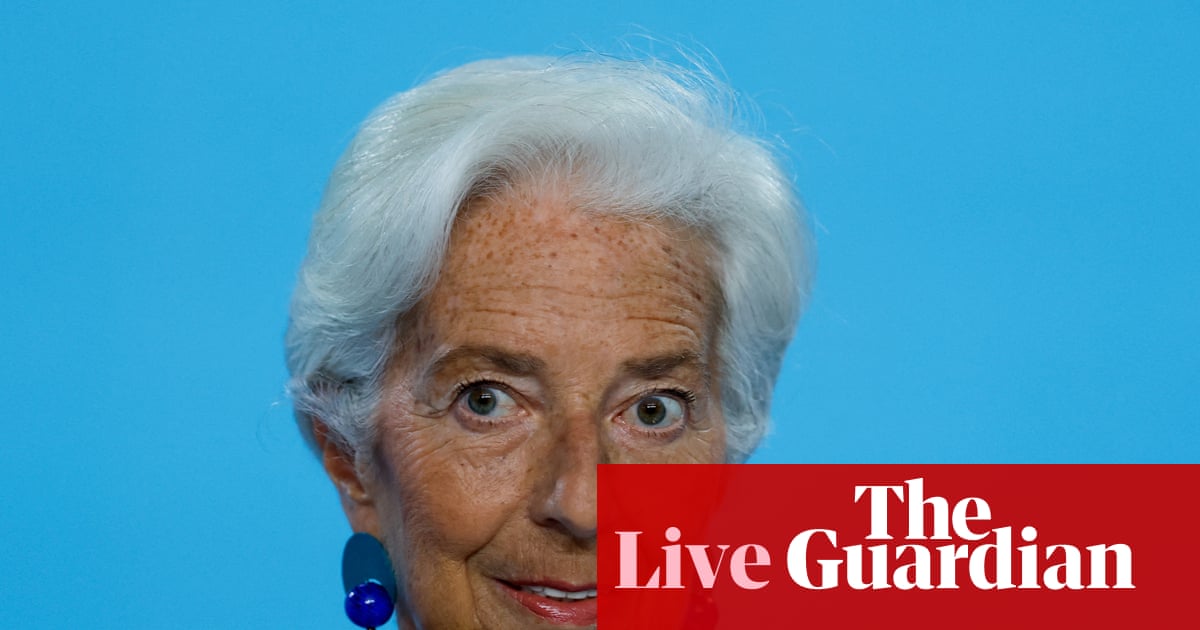
European Central Bank leaves interest rates unchangedThe European Central Bank has left its monetary policy unchanged, after a run of eight quarter-percentage-point cuts in the space of the last year.The ECB’s main policy rate will remain at 2%, while its deposit rate will stay at 2.15%, the Frankfurt-based central bank announced on Thursday.The policy rate has halved from 4% to 2% in an effort to spur the European economy, after inflationary pressures fell back.ShareUpdated at 13.15 BSTKey eventsShow key events onlyPlease turn on JavaScript to use this featureThe ECB will follow a “data-dependent and meeting-by-meeting approach”, Christine Lagarde repeats.The ECB’s governing council is determined to keep inflation at its 2% target, she adds. And with that she will take questions.ShareRisks to economic growth remain tilted to the downside, Christine Lagarde says – hardly a surprise when Donald Trump is looking at the US’s relationship with the EU.Russia’s invasion of Ukraine and the “tragic” conflict in the Middle East also add to uncertainty, she says.The path of inflation is more uncertain than normal because of the trade tensions, she says. Inflation could be higher if trade disruption disrupts supply chains, she adds, as happened during the coronavirus pandemic.ShareHigher investment in defence and infrastructure should support growth, Christine Lagarde says.She repeats the endless call of ECB officials to strengthen integration of the eurozone and its banking system.And then she goes into the easing inflationary pressures. Forward-looking indicators point to a further decline in wage growth, and consumer inflation expectations declined recently, she says.ShareChristine Lagarde takes to the podium in Frankfurt after leaving interest rates unchanged. She starts by reading out the decision.The economy grew more strongly than expected as companies “front-loaded” exports to avoid tariff hikes, but growth was also bostered by consumption, she says.Higher expected tariffs, a stronger euro and persistent uncertainty are making firms unwilling to invest, she says.ShareCould 2% be the end of the road for the latest rate cutting cycle?Mark Wall, chief European economist at Deutsche Bank, said:
As effectively telegraphed by Lagarde, the ECB paused the easing cycle in July. The question is, will this be a short pause or a long pause? And could this be a pause that sees 2% policy rates eventually become the terminal rate in this easing cycle?
Uncertainty remains high and the ECB rightly wants to keep its options open. But if trade uncertainty fades, the combination of a resilient economy and significant fiscal easing will eventually translate into upside risks to inflation. Markets are not far away from switching focus from the last cut to the first hike.
We will hear what Christine Lagarde has to say very shortly.ShareThere is very little reason for the ECB to leave its “good place” of standing on the sidelines waiting for more trade developments, said Carsten Brzeski, global head of macro at ING, an investment bank.In a note to clients, he said:
After seven consecutive 25 basis point [0.25 percentage point] rate cuts and a total of 200 basis point rate cuts since September 2023, the European Central Bank kept its policy interest rates on hold at today’s meeting.
A stronger euro had argued for further cuts, Brzeski said, but that pressure diminished as the euro eased.
Not only did the euro’s appreciation come to an end, but the repeatedly postponed showdown in the US-EU trade negotiations also offered another reason to stay put today and keep the powder dry.
Still, with two more weaker inflation prints and hard macro data weaker than soft data over the summer, we can still see one final rate cut at the September meeting.
ShareTrade wars make for ‘exceptionally uncertain’ conditions, says ECBThe ECB said in its monetary policy decision that the European economy has “proven resilient”, but flagged “exceptionally uncertain” conditions caused by Donald Trump’s trade wars.The central bank said it would take a “meeting-by-meeting approach” on deciding the path of interest rates – and it would not commit to a rate path now.It said:
Domestic price pressures have continued to ease, with wages growing more slowly. Partly reflecting the governing council’s past interest rate cuts, the economy has so far proven resilient overall in a challenging global environment. At the same time, the environment remains exceptionally uncertain, especially because of trade disputes.
ShareEuropean Central Bank leaves interest rates unchangedThe European Central Bank has left its monetary policy unchanged, after a run of eight quarter-percentage-point cuts in the space of the last year.The ECB’s main policy rate will remain at 2%, while its deposit rate will stay at 2.15%, the Frankfurt-based central bank announced on Thursday.The policy rate has halved from 4% to 2% in an effort to spur the European economy, after inflationary pressures fell back.ShareUpdated at 13.15 BSTThere are a few minutes left before the European Central Bank announces its latest interest rate decision.All bets are on a hold at 2% for the main interest rate and 2.15% for the deposit rate. Market movements imply a 94% probability of policy staying unchanged (so expect fireworks if anything is different).Matthew Ryan, head of market strategy at financial services firm Ebury, said that Christine Lagarde will try not to rock the boat today. He said:
Given this unusually elevated uncertainty, President Lagarde, who has a penchant for providing very little in the way of forward guidance, has even less incentive to hint at the path ahead for rates.
She is instead likely to largely repeat her message from June, when she said that policy was “in a good place”, and that the ECB was nearing the end of its cutting campaign. At the same time, she is unlikely to close the doors to further rate adjustments, particularly as tariff escalation could have disinflationary implications for the Eurozone. In the ECB’s “severe” scenario, which assumes higher tariffs and increased trade uncertainty, the bank expects weaker price pressures, particularly in the longer term.
ShareUpdated at 13.09 BSTJason RodriguesA Guardian report in 1953 about figures released by the Society of Motor Manufacturers and Traders (SMMT) Photograph: G/GdnThe mood at the Society of Motor Manufacturers and Traders (SMMT) today, following their gloomy news that the UK’s car industry output has dropped in the first half of 2025 to levels not seen since 1953 (aside from the coronavirus pandemic lockdown period), is probably quite different from 72 years ago.This upbeat piece by the Manchester Guardian’s motoring correspondent in October 1953 told readers that figures from the SMMT were so positive that the UK car industry had ‘become the mainstay of the national economy’.The income from UK vehicle exports was highlighted in the article, noting that after the war, car manufacturers had got into their stride, with the value of car exports rising from £68 million to £200 million per year during the 1950s.Whereas the uncertainty around the export of UK cars to the US, caused by the Trump administration’s tariffs, has reportedly had a negative impact on current output, back in 1953 the outlook for UK car makers hoping to break into the traditionally tough US market couldn’t have been rosier.One car, the eye-catching UK-made Jaguar XK 120 convertible, had won many admirers in the US, filling the order books of British exporters. Readers here were told that ‘Americans who could afford more than one car demanded that their family vehicle should be American, but their sports car should be characteristically British.’ShareUpdated at 12.40 BSTA posed photo of a woman stealing a bottle of wine and hiding it in a handbag in a supermarket. Photograph: Vitalij Chalupnik/AlamyThe number of shoplifting offences in England and Wales rose to a new record high in the year to March, continuing the marked increase in the crime since the coronavirus pandemic.There was a 20% increase in shoplifting offences to 530,643 in the year to March, according to the Office for National Statistics (ONS). “Theft from the person” – which includes pickpocketing and snatching items such as phones – also increased by 15% to 151,220.The ONS said:
There have been sharp rises in these offences since the pandemic. Both shoplifting and theft from the person offences are at their highest level since current police recording practices began in YE March 2003.
The rise in shoplifting has been partly seen as the result of squeezed household finances amid high inflation in recent years, but the British Retail Consortium (BRC), an industry body, has previously blamed it on organised gangs stealing to order.Tom Ironside, director of business and regulation at the BRC, said:
The ONS figures prove what retailers have long been telling us – that retail theft is spiralling out of control. Sadly, such theft is not a victimless crime; it pushes up the cost for honest shoppers and damages the customer experience for everyone.
Retail theft costs retailers, and their customers, over £2.2bn a year and are a major trigger for violence and abuse against staff. While the causes are manifold, the rise in organised crime is a significant concern, with gangs hitting store after store, even within a single day.
ShareUpdated at 12.30 BSTBritish Prime Minister Keir Starmer greets India’s Prime Minister Narendra Modi upon his arrival at the Chequers sstate, the UK prime minister’s country residence, near Aylesbury, on 24 July 2025. Photograph: Chris J Ratcliffe/EPAThe UK and India have signed a long-awaited trade deal. Keir Starmer said the UK-India agreement was “the biggest and most economically significant” trade deal Britain has made since Brexit.The prime minister said:
Look, we both know this is the biggest and most economically significant trade deal that the UK has made since leaving the EU.
And I think I can say that it’s one of the most comprehensive deals that India has ever done. So thank you, prime minister, for your leadership and for your pragmatism.
The deal will open up trade between the UK and India for cars, whisky, clothing and food products, writes political correspondent Eleni Courea.
For the UK, the agreement promises a much-needed economic boost and serves as proof that the country can be nimble on the international stage after Brexit.
For India, it acts a signal to governments and international investors that its £3tn economy is opening up after decades of protectionism. India’s average tariff rate is 13%, compared with the UK’s 1.5%.
You can read the full analysis here:SharePjotr SauerA still image taken from a handout video made available by the Ministry of Emergency Situations of Russia for the Amur Region shows smoke rises from the plane crash site of an An-24 passenger plane of Angara Airline in far east Amur region, Russia, 24 July 2025. Photograph: Russian Ministry Of Emergency Situations/HANDOUT HANDOUT/EPAA passenger plane has crashed in Russia’s far east after disappearing from radar, with 49 people on board feared dead, local officials have said.The flight, operated by Siberia-based Angara Airlines, vanished from radar on Thursday and lost contact with air traffic controllers while approaching its destination of Tynda, a remote town in the Amur region bordering China.An aerial inspection of the Soviet-era An-24 plane crash site found no survivors, the local emergency services told the state news agency, Tass. “According to preliminary information, all onboard were killed. So far, the rescue helicopter has been unable to land at the crash site,” an unnamed emergency official said.The An-24 is a twin turboprop regional aircraft designed by the Soviet Union’s Antonov Design Bureau in the late 1950s.You can read the full report here:ShareUpdated at 11.54 BSTLloyds boss warns Reeves against hiking taxes on banksKalyeena MakortoffChancellor Rachel Reeves talks with Lloyds Banking Group chief executive Charlie Nunn earlier this month. Photograph: Oli Scarff/PAThe boss of Britain’s largest mortgage lender has warned Rachel Reeves that increasing taxes on banks in her autumn budget would damage Labour’s plan for the City of London to power an economic recovery.Charlie Nunn, the chief executive of Lloyds Banking Group, said a rise in bank taxation “wouldn’t be consistent” with the chancellor’s overtures as the government pushes to reboot growth.Against a backdrop of mounting speculation that Reeves could use her autumn budget to announce a fresh round of tax rises, his comments came as the high street bank reported a 17% jump in second-quarter profits.Nunn told journalists on Thursday the bank had not had any discussions with the government about a potential tax rise, and acknowledged that it was ultimately a “political decision”. However, he said that targeting the financial services sector with higher taxes would mark a stark reversal by the chancellor, who last week announced a raft of changes to cut regulation and boost growth across the sector.You can read the full story here:ShareThe sculpture of an eagle looks out from behind protective construction wrapping on the facade as the Federal Reserve Board Building undergoes both interior and exterior renovations, in Washington, in 2023. Photograph: J Scott Applewhite/APEuropean Central Bank president Christine Lagarde will be in front of the world’s media this afternoon when she announces the latest interest rate decision, but it might be the Federal Reserve’s Jerome Powell who is having the more nervous wake-up today.That is because the Fed is going to host President Donald Trump for a visit. It is not a social call. Trump has repeatedly expressed his outrage with Powell after the central banker refused to cut interest rates. In response, Trump has zeroed in on a potential weakness for Powell: the over-budget renovation of the Federal Reserve building.The White House claims that the Fed mismanaged funds for renovations, which were approved in 2017 and were estimated to cost $1.9bn in 2019. The costs are now estimated to be closer to $2.5bn. The Associated Press reported:
When asked last week if the costly rebuilding could be grounds to fire Powell, Trump said, “I think it is.”
“When you spend $2.5bn on, really, a renovation, I think it’s really disgraceful,” Trump said.
The Fed has felt forced to respond to the accusations, but it is unclear whether Trump will actually follow through on his threat to fire Powell. Given how central banker independence has become prized by global markets – freeing interest rates from nakedly political influence – firing Powell would almost certainly set off market ructions as investors adjusted to the expectation of higher interest rates.ShareLondon’s FTSE 100 reaches new record highThe gain this morning on London’s FTSE 100 has pushed it to the latest record high.The peak this morning was 9,158.21 points. Let’s see if it will go higher today.Share
970x125
970x125
